
Article
DETAILS
informed decisions, maintain your property, and ensure long-lasting protection.
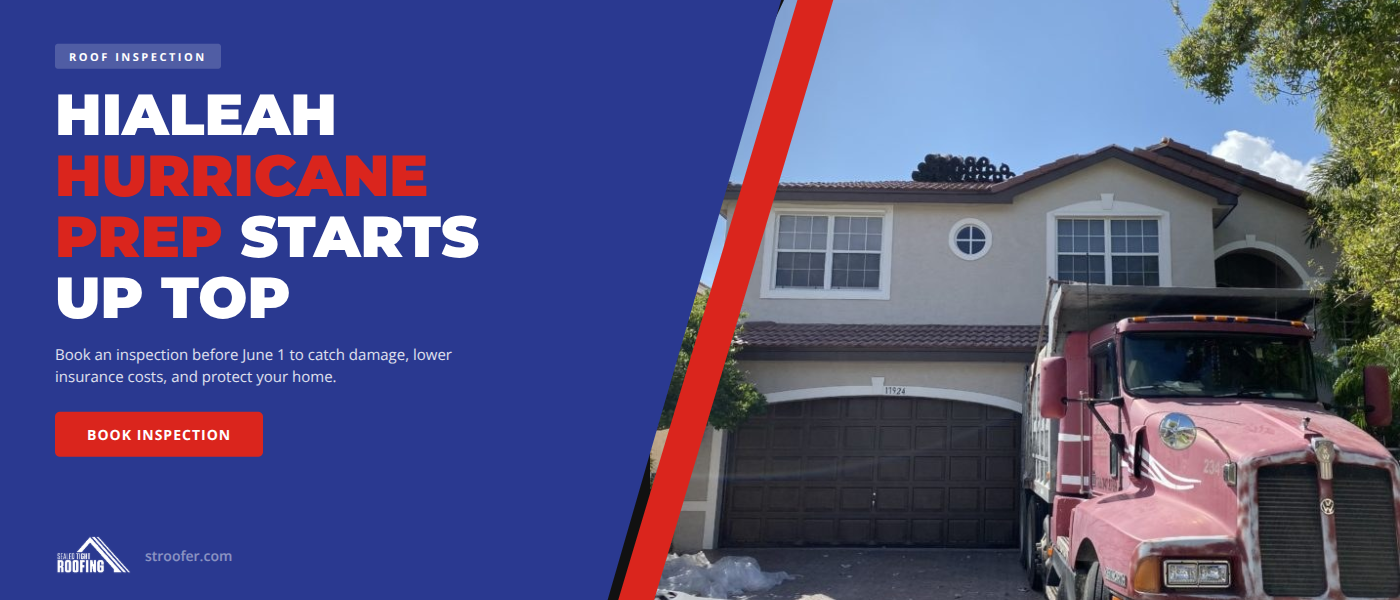
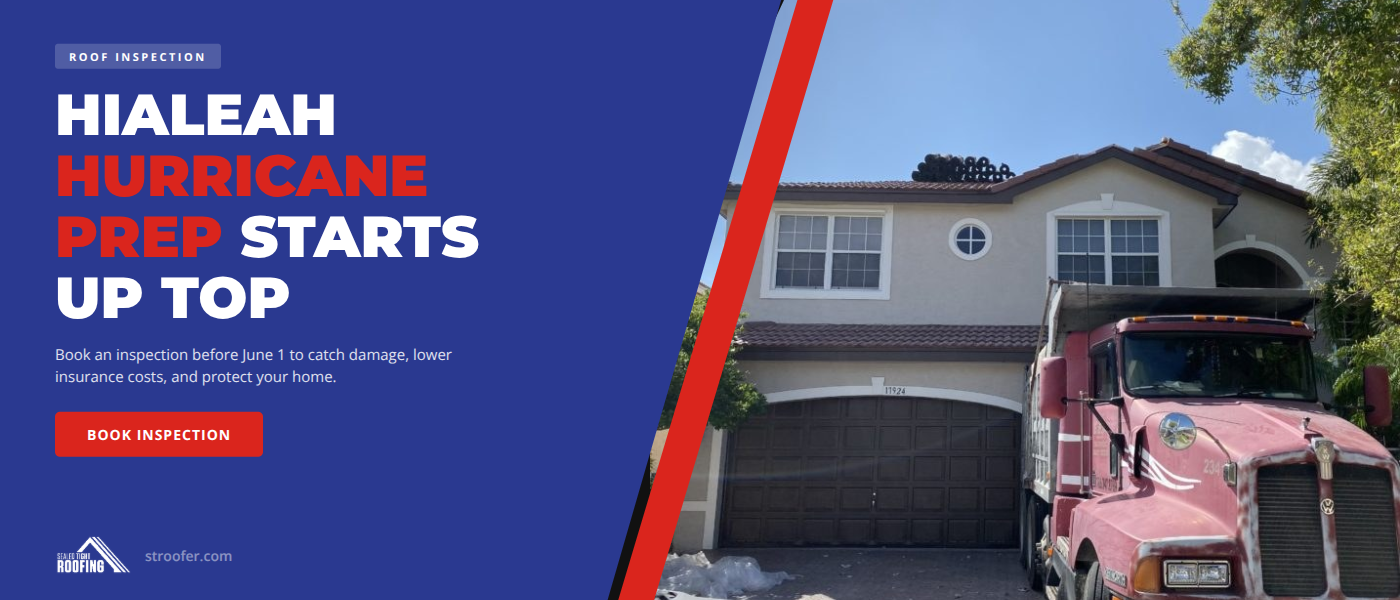
Why Hialeah Homeowners Need a Roof Inspection Before Hurricane Season
Hurricane season starts June 1, and for Hialeah homeowners that date is less a calendar marker and more a deadline. The roof is the single component most exposed to whatever the Atlantic sends our way — and the one insurance carriers, Miami-Dade inspectors, and adjusters scrutinize hardest after a named storm. A pre-season roof inspection in Hialeah, FL is the cleanest way to know what you are heading into and to fix small problems before they become catastrophic ones.
At Sealed Tight Roofing, we have inspected, repaired, and replaced more Hialeah and Miami-Dade roofs than we can count, and the pattern repeats every year. Roofs that pass a thorough April or May inspection ride out the season with minor issues at most. Roofs that get skipped become June and July emergencies. This guide covers why late spring is the right time, what an insurance-grade inspection includes, what we typically find on Hialeah homes, how wind mitigation reports affect premiums, and what to do if your roof does not pass.
Why Late Spring Is the Best Time for a Hialeah Roof Inspection
Late April and May are the calmest part of the calendar for South Florida roofers. Daytime highs in Hialeah climb into the upper 80s, the dry season is winding down, and hurricane activity is still weeks out. That window matters for three reasons.
First, it is the only stretch of the year when most reputable inspectors and contractors actually have schedule availability. Once the National Hurricane Center begins its Tropical Weather Outlooks in mid-May and the first systems churn up in June, inspection requests spike and any repair work competes with hundreds of emergency jobs across South Florida.
Second, repairs take time. A Hialeah inspection that turns up cracked tiles, lifted flashing, or soft decking realistically takes two to six weeks to permit, schedule, and complete — longer for a full reroof. Third, insurance documentation has lead time. Wind mitigation and 4-Point reports can take a couple of billing cycles to apply, so an inspection before June 1 keeps the paperwork ahead of the storm season.
What an Insurance-Grade Roof Inspection Includes in South Florida
A real inspection is not a five-minute walk around the perimeter. Our standard for Hialeah homes covers both the visible roof surface and the structural systems underneath, and produces a written, photo-documented report that holds up if you need to file a claim or document mitigation upgrades to your carrier. A complete pre-hurricane inspection in Hialeah typically includes:
- Full surface walk or drone survey — every slope, ridge, hip, valley, and edge documented with date-stamped photos
- Tile, shingle, or membrane condition check — cracked or slipped tiles, granule loss, blisters, seam separation, ponding
- Flashing and penetrations — chimneys, skylights, plumbing vents, AC stands, and any rooftop equipment
- Underlayment and decking assessment — soft spots, exposed deck, age of the secondary water barrier
- Attic interior inspection — light penetration, water staining, daylight at the eaves, deck attachment hardware
- Drainage — scuppers, downspouts, parapet drains on flat roofs
- Wind mitigation features — straps, clips, sealed deck, secondary water barrier, opening protection
- Code and permit history — Miami-Dade permit records and prior NOA-approved product installations
For older Hialeah homes, the carrier may also request a 4-Point inspection — roof, electrical, plumbing, HVAC — separate from the wind mitigation report. Homes built before 2002 often need both documents to keep coverage active.
Common Hurricane-Season Roof Vulnerabilities Found on Hialeah Homes
Hialeah's housing stock is a mix of 1950s through 1970s single-family homes with original or once-replaced barrel tile, newer townhomes with concrete tile, and flat-roofed commercial and multifamily buildings. Each category has its own predictable vulnerabilities heading into hurricane season. The issues we find most often during pre-hurricane inspections in Hialeah include:
- Loose or slipped tiles at hips and ridges — wind pulls these first, and once one goes the surrounding field is exposed
- Cracked tiles from foot traffic and UV — 40-year-old barrel tile often cracks the year someone walks it carelessly
- Failed mortar at hip and ridge caps — older Hialeah tile roofs finished with mortar crumble over time and let wind under the cap
- Aged underlayment — the asphalt-saturated felt under tile typically lasts 15 to 25 years; once it fails the tile is essentially decoration
- Lifted or rusted flashing — chimneys, skylights, and step-flashing are the most common leak entry points after wind
- Soft or rotted decking from prior leaks — small unrepaired leaks compromise the deck's ability to hold fasteners during uplift
- Compromised parapet caps and seams on flat roofs — wind-driven rain works any seam open
- Clogged scuppers and drains — flat roofs that pond water during a storm gain hundreds of pounds of dead load
None of these are catastrophic on their own in April. All become catastrophic when a Category 1 squall pushes through in August.
Wind Mitigation Inspections and How They Lower Your Insurance Premiums
The Florida Office of Insurance Regulation requires every home insurance carrier in the state to offer premium discounts for wind-mitigating roof features. The document that triggers those discounts is the Uniform Mitigation Verification Inspection Form (OIR-B1-1802). As of April 1, 2026, an updated version of that form is required for all submissions — see the Florida OIR wind mitigation resources page for the current form. The inspection scores seven categories on your roof and openings:
- Building code year — when the structure was permitted under the Florida Building Code
- Roof covering — whether it meets current FBC and Miami-Dade product approvals
- Roof deck attachment — nail size, spacing, and pattern
- Roof-to-wall connection — toe-nails, clips, single wraps, or double wraps
- Roof geometry — hip, gable, or flat, with hip roofs scoring strongest
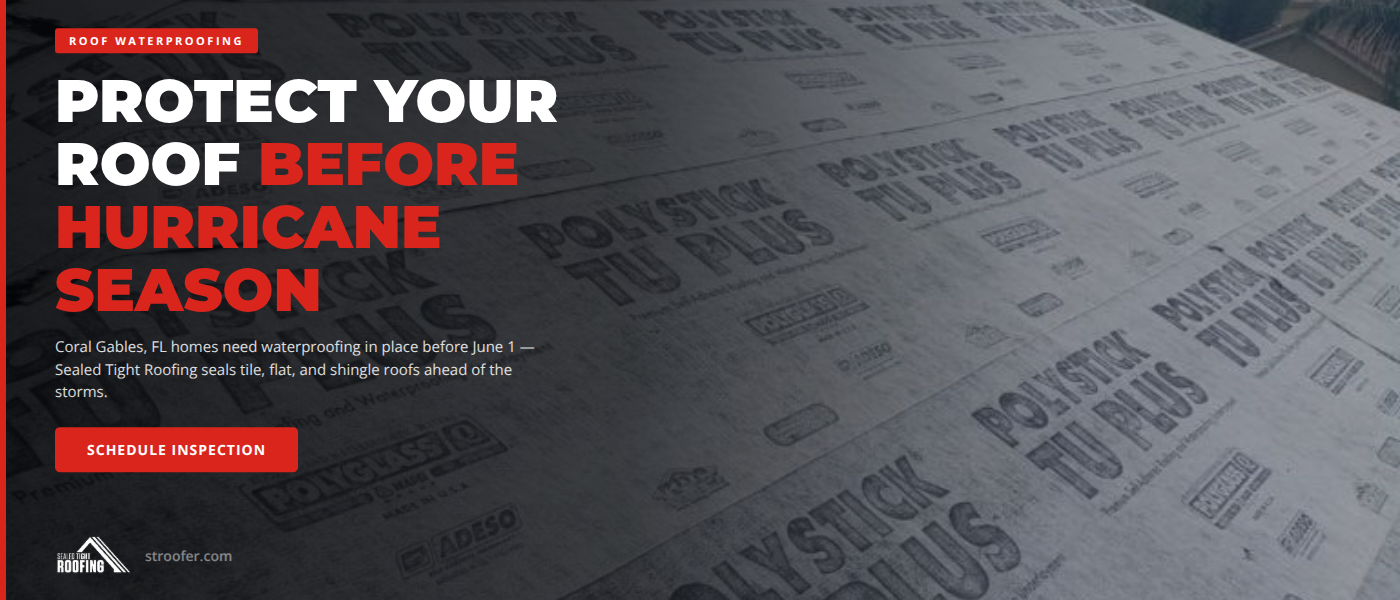
- Secondary water resistance — a sealed-deck membrane that keeps water out if the primary covering blows off
- Opening protection — impact-rated windows, doors, and shutters across all openings
Discounts on the wind portion of your premium typically range from 10 to 45 percent, and on a Hialeah home with full impact protection and a sealed deck, the savings often pay for the inspection many times over. Many homeowners also qualify for grant funding through Florida's state-funded wind mitigation grant program, which covers no-cost inspections and matching grants for eligible upgrades like impact windows and stronger roof attachments.
Tile, Shingle, and Flat Roofs: What Inspectors Check on Each
Hialeah has all three roof types in heavy use, and the inspection priorities shift depending on what is over your head.
Tile Roofs
Concrete and clay tile dominates Hialeah single-family neighborhoods. Inspectors check every tile for cracks and slippage, every hip and ridge for loose mortar or failed adhesive set, and underlayment age wherever visible. Tile that looks fine from the street often has dozens of broken pieces visible only from above. Per Miami-Dade code, completed adhesive-set tile systems must pass a static uplift test confirming tile-to-underlayment adhesion before the final inspection signs off.
Shingle Roofs
Shingle is less common in Hialeah than tile but still present, especially on additions and post-2000 construction. Inspectors look at granule loss, lifted edges, exposed nails, and any thermal cracking. The wind-rating of the shingle and the nail pattern underneath both feed directly into the wind mitigation score.
Flat Roofs
Flat roofs cover most Hialeah commercial buildings, many multifamily structures, and newer residential additions. The inspection focuses on seam integrity (TPO, modified bitumen, or built-up), drain and scupper function, parapet cap condition, and ponding patterns. Long-standing membrane patches often hide soft decking underneath; the only way to confirm is a careful tactile inspection across the field.
What to Do If Your Hialeah Roof Fails Its Pre-Hurricane Inspection
A failed inspection is not a disaster — it is information you would much rather have in May than discover after a storm in September. The next steps depend on what the report flagged.
For localized issues — cracked tiles in one section, lifted flashing around a skylight, a soft area near a vent stack — targeted roof repair and maintenance is usually the right call. Focused repairs can be permitted and completed within a few weeks in late spring and preserve the remaining service life of an otherwise sound roof.
For widespread problems — failed underlayment, decking compromised in multiple areas, or a covering past its service life — full reroofing is the more economical long-term move. A reroof in late spring is also the cleanest opportunity to upgrade the wind mitigation profile: NOA-approved Miami-Dade products, a sealed secondary water barrier, and an improved deck attachment all become straightforward during a tear-off, and each upgrade feeds directly into a better mitigation report and lower premium.
Either path requires a Miami-Dade County permit. The required inspections and affidavit of compliance for deck attachment and secondary water barrier are spelled out in Miami-Dade's hurricane mitigation guidance.
Why Local Experience Matters When Choosing a Hialeah Roof Inspector
Miami-Dade is the strictest roofing jurisdiction in the country. Roofs in our county must withstand wind speeds approaching 175 mph, and every roofing product installed must carry a Miami-Dade Notice of Acceptance (NOA). An inspector or contractor who works primarily outside South Florida rarely knows the current NOA list, the inspection sequence Miami-Dade requires, or the realities of Hialeah's housing stock.
Local experience matters in three concrete ways. The inspector knows what to look for — 1960s barrel tile with original mortar caps behaves nothing like 2010s concrete tile with foam-set hips. The report is written in the language carriers expect, with wind mitigation forms filled out correctly and recommendations tied to NOA-approved products. And the relationships are already in place — with the county permit office, the inspectors, and the suppliers who carry the right materials in stock during peak season.
Sealed Tight Roofing serves Hialeah and the surrounding Miami-Dade communities including Miami, Miami Gardens, Miami Lakes, Miami Springs, Opa-locka, Hialeah Gardens, Doral, Aventura, and North Miami. Spring is the right window to schedule — we would rather find a problem in April than meet you on the wrong side of a storm.
Frequently Asked Questions About Roof Inspections in Hialeah
When should I get a roof inspection in Hialeah?
The ideal window is late April through May, before hurricane season begins June 1 and before South Florida inspector and contractor schedules fill up. Homes that have not been inspected in the last two years, homes near the end of their roof's service life, and homes with any leak history should be a priority. Post-storm inspections are also routine after any named system passes through Miami-Dade.
What does a hurricane season roof inspection cost?
Pricing varies with the size and type of roof, whether a 4-Point inspection is included, and whether you need a wind mitigation report. Many Florida homeowners qualify for a no-cost wind mitigation inspection through the state-funded Florida grant program. Outside that program, a full residential pre-hurricane inspection in Hialeah is a modest investment compared with the premium savings a strong mitigation report can unlock.
How do I pass a wind mitigation inspection in Florida?
The inspection is not pass/fail — it scores seven categories that determine your premium discount. To maximize the score, the home should have a Miami-Dade NOA-approved roof covering, a sealed secondary water barrier, hurricane clips or straps at the roof-to-wall connection, an upgraded deck attachment pattern, hip-shaped roof geometry where possible, and impact-rated protection on every opening. Many of those features can be added during a reroof or as targeted upgrades.
Will a roof inspection void my insurance or warranty?
No. A professional inspection by a licensed Florida roofing contractor does not void coverage or product warranties. Most carriers and manufacturers expect periodic inspections, and the documentation typically supports rather than undermines a future claim.
Does Sealed Tight Roofing serve Hialeah for inspections?
Yes. We provide pre-hurricane and post-storm roof inspections in Hialeah, FL along with full repair, reroofing, and waterproofing across Miami-Dade and Broward. Reach out before June 1 so any recommended repairs or mitigation upgrades have time to be completed before peak season.

RELATED ARTICLS
Let’s protect your home
with expert roofing.