
Article
DETAILS
informed decisions, maintain your property, and ensure long-lasting protection.
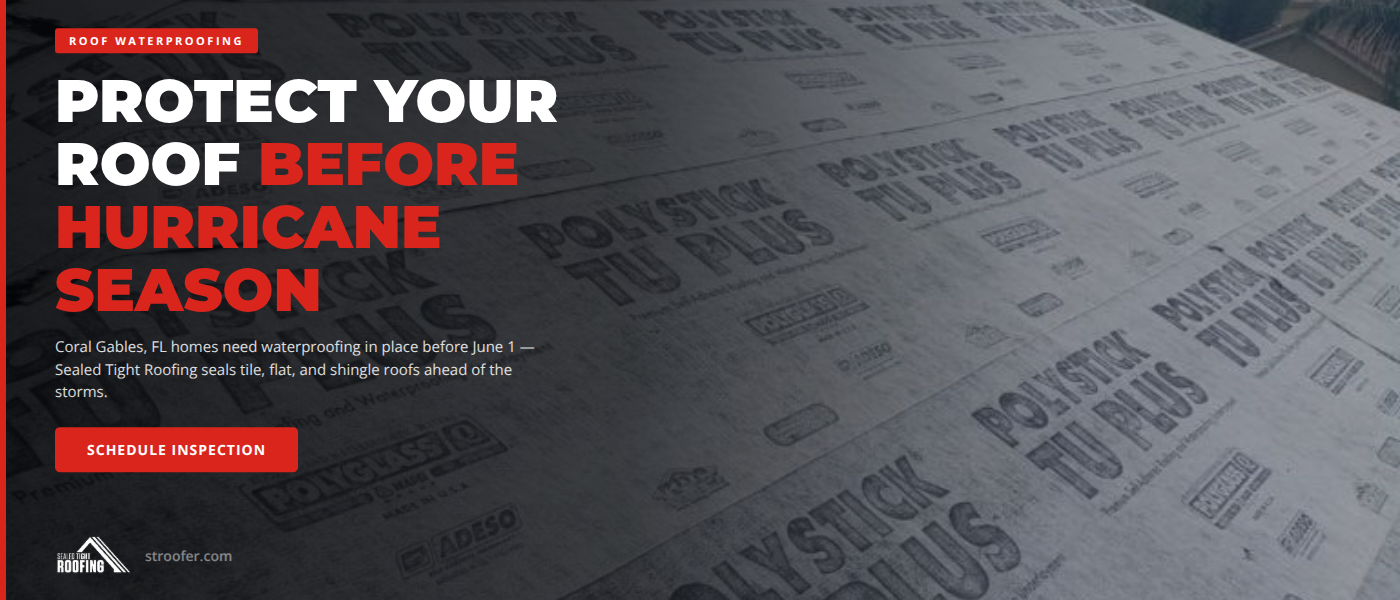
Roof Waterproofing in Coral Gables, FL: Pre-Hurricane Protection for Your Home
Hurricane season starts June 1, and in Coral Gables that date is when South Florida's calmest months hand the calendar back to the Atlantic. Mediterranean Revival tile roofs, flat parapet roofs over additions and pool houses, and the older barrel-tile work that defines so many of our city's blocks all share one weakness in common — the moment water finds a way in, the damage compounds quickly. Professional roof waterproofing in Coral Gables, FL is the most direct way to keep wind-driven rain out of the assembly before the first named system makes its run at South Florida.
At Sealed Tight Roofing, we have waterproofed, repaired, and replaced roofs across Coral Gables and the rest of Miami-Dade for years, and the pattern is consistent. Roofs treated with the right waterproofing system in late spring ride out hurricane season with no surprises. Roofs that get skipped become the August call we rush to in standing water. This guide covers why Coral Gables homes are uniquely exposed, how our humidity quietly degrades unprotected roofs, the specific waterproofing methods we use, the warning signs to look for, what a project actually involves, and how the upgrade pays you back through insurance and home value.
Why Coral Gables Homes Need Roof Waterproofing Before Hurricane Season
Coral Gables sits inside Miami-Dade County's High Velocity Hurricane Zone (HVHZ), the strictest building-code zone in the country for wind and water resistance. The architecture that gives the city its character — clay barrel tile on Mediterranean Revival homes, low-slope flat roofs on coach houses and additions, the elaborate hip-and-valley geometry on George Merrick-era estates — is also unusually vulnerable to wind-driven rain. Tile sheds water beautifully when intact, but each cracked or slipped piece becomes an entry point the moment a tropical squall pushes rain sideways at 60 mph.
Late April through May is the right window for three reasons. First, reputable contractors and inspectors still have schedule availability before the National Hurricane Center begins its Tropical Weather Outlooks in mid-May. Second, waterproofing systems need clean, dry conditions to cure — late spring gives us the longest dry windows of the year. Third, if a thorough roof inspection turns up issues, the repair, permit, and application sequence realistically takes two to four weeks, and Miami-Dade permitting volumes spike once June arrives.
How South Florida Rain and Humidity Damage Unprotected Roofs
Coral Gables averages more than 60 inches of rainfall per year, most of it concentrated in the May-through-October wet season, and our relative humidity sits in the 70 to 90 percent range almost year-round. That climate works on a roof in ways most homeowners never see. Asphalt-saturated felt underlayment — the secondary water barrier under tile — typically lasts 15 to 25 years in our climate before it grows brittle and cracks. Once that membrane fails, the tile above it is essentially decoration; any water that gets past the tile reaches the deck unimpeded.
Humidity also corrodes flashings and fasteners from the inside out around chimneys, skylights, vents, and HVAC stands. Daily thermal cycling on flat roofs — surface temperatures climb from the mid-70s overnight to well over 150 °F at midday — opens hairline cracks at every seam, lap, and parapet cap. UV radiation degrades older bituminous membranes year after year, and salt-laden air drifting in from Biscayne Bay accelerates the breakdown of any uncoated flashing in eastern Coral Gables neighborhoods.
None of that damage is visible from the street. By the time a brown stain reaches a ceiling, the deck above it has been wet for months.
Roof Waterproofing Methods We Use on Coral Gables Properties
There is no single waterproofing product that fits every roof in Coral Gables. The right method depends on roof type, age, slope, substrate, and what the inspection reveals. The systems we install most often on Coral Gables properties include:
- Elastomeric roof coatings — a high-build acrylic, silicone, or hybrid topcoat applied over flat roofs and tile. These coatings flex with daily thermal movement, reflect heat, and form a seamless waterproof membrane. Properly specified elastomeric systems on Miami-Dade tile roofs have been documented withstanding 135+ mph winds.
- Self-adhering peel-and-stick underlayment — code-required in the HVHZ during reroofs. The membrane bonds directly to the deck and around fasteners so any water that gets past the primary covering stops at the deck.
- Sealed-deck secondary water barrier — a continuous code-recognized membrane across the entire roof deck before the underlayment goes down. This is the single feature that scores highest in the secondary water resistance category on the wind mitigation form.
- Tile re-bedding and ridge sealing — failed mortar at hip and ridge caps replaced with NOA-approved adhesive foam, eliminating one of the most common wind-uplift entry points on older Coral Gables tile roofs.
- Flashing replacement and seam sealing — every chimney, skylight, vent stack, and rooftop unit gets new flashing, properly stepped and sealed with HVHZ-rated sealants.
- Modified bitumen and TPO membrane systems — for flat roof sections, multi-ply modified bitumen or single-ply TPO with heat-welded seams provides a continuous HVHZ-approved waterproof membrane.
Every product we install in Coral Gables carries a Miami-Dade Notice of Acceptance (NOA). You can verify any product approval through the Florida Building Code product approval database — we encourage homeowners to do exactly that.
Signs Your Coral Gables Roof Is Already Letting Water In
The warning signs of a roof waterproofing failure usually appear inside the home before they are obvious from the roof itself. The patterns we see most often on Coral Gables properties include:
- Ceiling stains or rings, especially near chimneys, skylights, exterior walls, or under valley intersections
- Bubbling or peeling paint on ceilings, soffits, or upstairs interior walls
- Mildew or musty odor in attics, closets, or upstairs rooms — particularly after a heavy rain
- Visible daylight through the attic at the eaves, ridge, or around penetrations
- Cracked, slipped, or missing tiles visible from the ground or street level
- Crumbling mortar at hip and ridge caps on older barrel-tile roofs
- Ponding water on flat roofs more than 48 hours after rain has stopped
- Granule accumulation in gutters or downspouts on shingle sections
- Rust or staining on flashing around chimneys, skylights, or HVAC stands
Any single sign warrants a professional inspection. Two or more typically means water has already reached the deck and the assembly is degrading from the inside.
What to Expect During a Roof Waterproofing Project
A typical Coral Gables waterproofing project begins with a complete inspection — a full surface walk or drone survey, attic check, photo documentation, and a written report identifying every area that needs attention before the waterproofing system can be applied. We pull the Miami-Dade County permit, schedule the work around weather, and brief the homeowner on the day-by-day sequence.
Surface preparation is the step that makes or breaks a coating system. We pressure wash the entire roof to remove dirt and biological growth, let it dry completely, replace any cracked or slipped tiles, repair flashing, re-bed loose ridge and hip caps, and prime the surface with a manufacturer-specified primer. The waterproofing topcoat — typically two cross-rolled coats — goes on only when the substrate is clean, dry, and primed. Most systems are walk-on within 24 hours and fully cured within a week.
The project closes with a Miami-Dade County final inspection, manufacturer documentation, and the warranty package. For projects that include a sealed deck or new underlayment, we also generate the wind mitigation documentation the homeowner needs for the insurance carrier. Most residential Coral Gables waterproofing projects complete in three to seven working days.
How Roof Waterproofing Helps Your Insurance Claim and Home Value
The Florida Office of Insurance Regulation requires every home insurance carrier in the state to offer premium discounts for wind- and water-mitigating roof features, scored on the Uniform Mitigation Verification Inspection Form (OIR-B1-1802). Two of the seven categories on that form — secondary water resistance and roof covering — are directly affected by the waterproofing system on the roof. Coral Gables homes with a documented sealed-deck secondary water barrier and an HVHZ-approved coating or membrane consistently score in the highest discount tier, which typically lowers the wind portion of the premium by 10 to 45 percent.
Many Florida homeowners also qualify for grant funding through Florida's state-funded wind mitigation grant program, which covers no-cost mitigation inspections and matching grants for eligible upgrades — secondary water barriers and roof-deck attachment improvements both qualify. Combined with the carrier discount, the math frequently works out so that the waterproofing system pays for itself well inside its service life.
The home-value side is just as concrete. A waterproofed roof prevents the slow, hidden damage — saturated decking, rotted truss tails, mold in attic insulation, water-stained ceilings — that destroys appraisals and kills sales contracts in Coral Gables. A documented HVHZ-approved waterproofing system with a manufacturer warranty and Miami-Dade permit history is one of the cleanest disclosures a seller can offer.
Why Local Experience Matters for Roof Waterproofing in Coral Gables
Miami-Dade is the strictest roofing jurisdiction in the country. Roofs in our county must withstand wind speeds approaching 175 mph, and every product installed must carry a Miami-Dade NOA. A contractor working primarily outside South Florida rarely knows the current NOA list, the inspection sequence Miami-Dade requires, or the realities of waterproofing a 1925 Coral Gables Mediterranean Revival versus a 2010 flat-roofed pool-house addition.
Our team works under the same Miami-Dade hurricane mitigation guidance every day. The relationships are in place — with the permit office, the inspectors, and the suppliers who carry HVHZ-approved materials in stock during peak season. Sealed Tight Roofing serves Coral Gables along with Miami, Hialeah, Miami Lakes, Doral, Aventura, North Miami, and the rest of Miami-Dade and Broward. Spring is the right window — we would rather treat your roof in May than meet you on the wrong side of a storm.
Frequently Asked Questions About Roof Waterproofing in Coral Gables
How much does roof waterproofing cost in Coral Gables, FL?
Pricing depends on roof type, square footage, substrate condition, and the NOA-approved system the project calls for. Elastomeric coatings on flat roofs sit at a different price point than full sealed-deck systems installed during a reroof. Most Coral Gables homeowners also qualify for a no-cost mitigation inspection through the state grant program referenced above, and the wind-portion premium discount on a strong mitigation report often offsets a meaningful share of the cost over the system's service life.
What is the best roof waterproofing for South Florida homes?
The right system depends on the roof. For low-slope and flat roofs, a high-build silicone or hybrid elastomeric coating with documented HVHZ approval is typically the strongest choice. For tile roofs, the priorities are sealed-deck underlayment, NOA-approved adhesive foam at hip and ridge caps, and proper flashing. Self-adhering peel-and-stick underlayment is the code-required secondary water barrier during any HVHZ reroof.
How long does roof waterproofing last in Coral Gables?
Quality elastomeric coatings carry manufacturer warranties of 10 to 20 years when installed and maintained per spec. Sealed-deck secondary water barriers installed during a reroof are designed to match the service life of the primary covering — 20 to 30 years for tile, 15 to 25 years for membrane systems. We schedule a maintenance check every two to three years so any recoat or seam touch-up happens long before a failure.
Will roof waterproofing void my warranty?
No — when waterproofing is installed by a licensed Florida roofing contractor using NOA-approved products applied per the manufacturer's specifications, both the primary roof warranty and the new waterproofing warranty stay intact. We document every product approval and submittal so the paper trail is complete.
Does Sealed Tight Roofing serve Coral Gables for waterproofing?
Yes. We provide pre-hurricane and post-storm roof waterproofing in Coral Gables, FL along with full roof inspections, roof repair and maintenance, and reroofing across Miami-Dade and Broward. Reach out before June 1 so any waterproofing work — and the insurance documentation that goes with it — is complete before peak season.

RELATED ARTICLS
Let’s protect your home
with expert roofing.